• You're one step from joining Electricians Forum – Wiring, Code Compliance & Troubleshooting.
    Create a free account to post, follow threads, and never miss an update.  Sign up free →

Power surge

bkrog

New member
Joined
Jul 30, 2025
Messages
1
Iam having an issue with power surge in my home. Lights will dim appliances stop working or not work right. Depending on single phase or 3 phase. I unplugged appliance and the lights still dim. It is whole home, not just one circuit or another. It is a older home and electric panel. I have noticed that a 15 Amp breaker and 20 Amp breaker are loose in the panel. Any suggestions?
 
That sounds more like a voltage drop problem, not a power surge. A power surge would blow stuff out, not cause it to dim or run poorly. The fact that the entire house is affected and you have loose breakers is a major red flag. A loose connection creates resistance and heat, which is a huge fire hazard and the likely cause of your voltage issue. It's a safety hazard you shouldn't want to mess with. I highly recommend getting a professional electrician to inspect the main breaker connections and the service entrance wires coming into the panel. Also try calling your utility company. They might check their side of the connections for free.
 
@bkrog, I agree with @CircuitRick! That sounds like a serious voltage drop issue, not a surge. That bad connection can create a ton of resistance and heat, which is a major fire hazard!! I hope you call a pro immediately. This is a safety issue that needs to be addressed ASAP!!
 
Hi Bkrog,

I'm with CircuitRick and VoltagexV- Please have a licensed electrician inspect this as soon as you can. (Not a handyman)

After rectifying any problems in the home, she may install her recording meter for a few days. This meter's readings will be a good tool to convince the utility that they just take corrective action. (Assuming the problem is from the utility)

Until It's Fixed-
Sometimes when the voltage recovers after a voltage drop, there is a surge far above the nominal voltage. It would be wise to unplug any electronic items which may not handle the surge well. Don't rely upon plug-in surge suppressors. They help, but still can let a brief voltage spike through.

The loose circuit breakers that you found should be switched off until the electrician rectifies this. As mentioned by others, heat is the result. Arcing may occur as well.

Why The Drop?
The main drop problem may be as simple as a loose service entrance neutral connector in the load center. This is very common in older load centers and is especially common with aluminum service entrance conductors. They expand from normal warming and cooling; working the connection loose.

Other times, anti-oxidation paste was not used and the conductor oxidizes in the lug, creating resistance which impeded flow of electrons. This oxidation is common when the load center is in a damp location, such as a basement.
OR
Sometimes, the utility loses the neutral connection's integrity and the grounding electrode system is left to do the work of electron balancing. It can't send electrons to earth fast enough and voltage drop manifests.

Confused-
You mentioned, Bkrog, 3-phase. Being residential, I don't think 3-phase is in your home. I've only encountered residential 3-phase in the very largest of mansions. (As in 20,000+ square feet) We usually would put a pad mount transformer for 120/208 3-phase wye.

Hope yours is a simple & inexpensive repair! And, please let us know what the electrician finds.

Paul
 
I completely agree, this situation definitely needs a licensed electrician. With loose breakers and possible neutral faults, you can't afford to wait. I hope everything's already been taken care of by now and that the meter readings confirmed the repairs.
 
How old is the house + panel + meter-box + incoming-wires ? We await your story/resolution.

If you end up doing/needing a new panel, maybe even meter box and feed wires....
...make sure conduits,etc (if like mine, panel IN-house, just a meter box and upstream exposed to weather) are puttied/insulated super good. Though this is perhaps an insultingly obvious warning (insulate/putty,etc)... but seems like something to fret (if corroded, was it a moisture problem?).

I'm just a DIY homeowner, but I got my licensed contractor friends to replace panel + meter box +more, and do it right. I believe, for a prior MA house... 1989-built house but the panel had issues by 2010...no entire-home-flickering/etc issues, i forget which circuit got me looking deep in panel but one breaker was warm so I pulled a few others too. Issue(s): a handful of corroded breaker contact areas on lower bus positions....pitting grey metal (no longer smooth) on some bus bar areas.. of course breaker's contacts will suffer, get warm, show results of arcing but I blamed the bus bar. Never really proved where corrosion started...inside panel, top area(feed) dry+good...bottom breakers also dry but some pitted! So I never solved that mystery of why did it degrade ... had to assume something like storm-rain-seeping so minor I had no indication in basement.

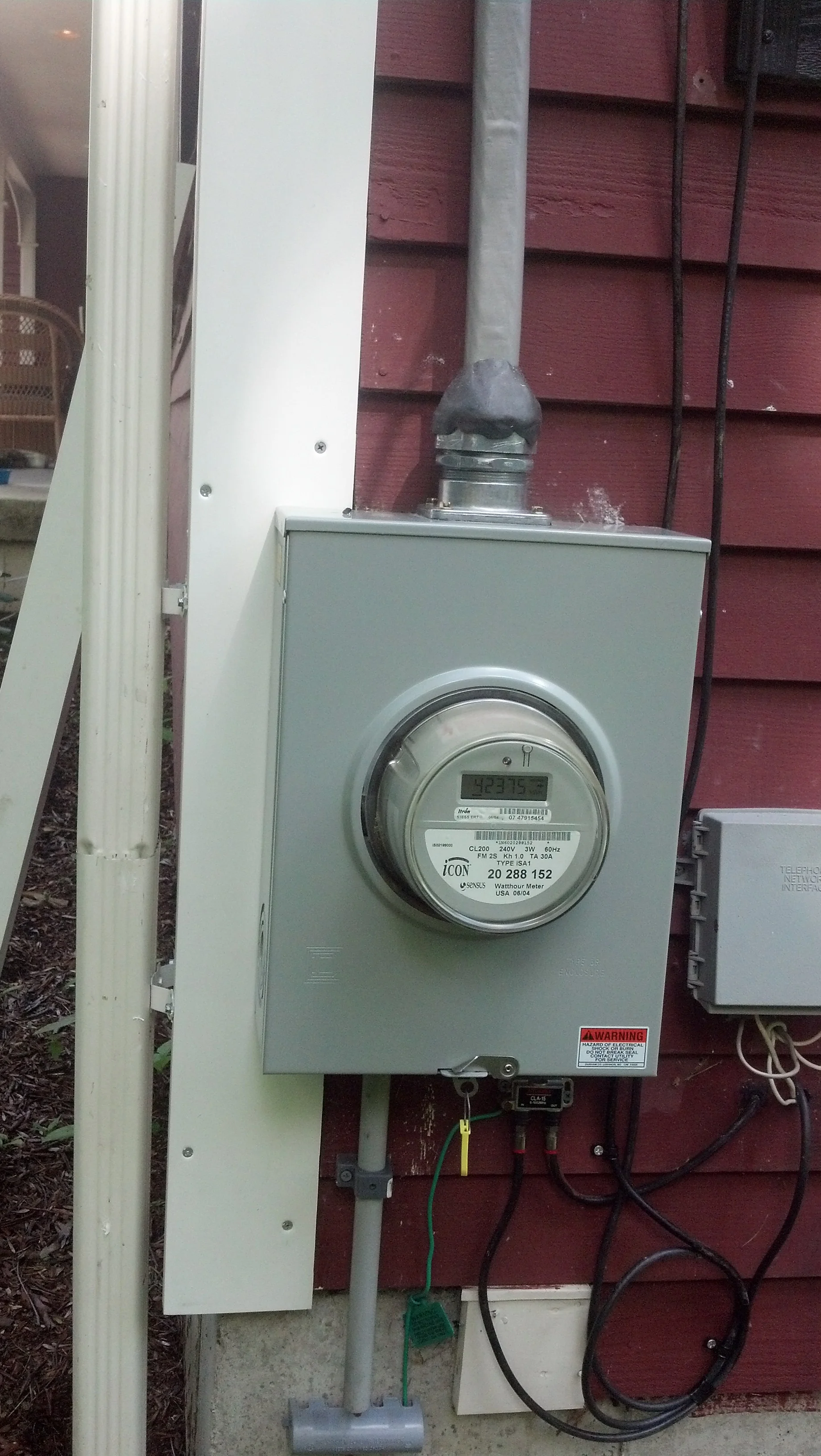
But as told above I DID get a new panel, new feed wires, attached pic shows (top) putty sealing the conduit to meter box, then there's a can't-see hole in the house wall, behind which in basement (INSIDE) is the panel. Panel/breakers 5-6ft above floor in a very dry and not-prone-to-humidity basement (foundation/cement-walls never leaked). Typical setup/design I assume...I've seen worse-looking setups lasting way more than 20 years!...such as....

My gf has a near-beach (1/4mi, just far enough away to avoid ocean salt air) Maine summer cottage with an OUTSIDE-HOUSE main panel. I just added a new circuit+breaker, yesterday was first time I removed the "dead front" shielded by a cover panel..it must be around 50 years old, but still good and minimal cobwebs, no dead or live bugs, amazing! You can bet I lightly filed/sanded the bus bar points for the bottom positions including the ones that were vacant. I didn't get them to be shiny grey metal, but they felt smooth enough. (NO PIC on that story.)
 

Attachments

  • IMG_20140531_150434_788.webp
    IMG_20140531_150434_788.webp
    610.5 KB
I have noticed that a 15 Amp breaker and 20 Amp breaker are loose in the panel.
this is a huge red flag. A loose connection creates resistance, which generates a lot of heat. This can not only cause the voltage drop you're seeing but can also be a significant fire hazard.
It's a problem that goes beyond a simple DIY fix. Don't touch it and let the pro handle it
 
Never really proved where corrosion started...inside panel, top area(feed) dry+good...bottom breakers also dry but some pitted! So I never solved that mystery of why did it degrade ... had to assume something like storm-rain-seeping so minor I had no indication in basement.
Is any chlorine used nearby? Example: Laundry, Swimming Pool, etc.
Chlorine can corrode metal just by being used nearby. For some reason, it goes after electrical devices with a vengeance.
 
Iam having an issue with power surge in my home. Lights will dim appliances stop working or not work right. Depending on single phase or 3 phase. I unplugged appliance and the lights still dim. It is whole home, not just one circuit or another. It is a older home and electric panel. I have noticed that a 15 Amp breaker and 20 Amp breaker are loose in the panel. Any suggestions?

I realize that this is a bit of an older thread, but I have to ask: do you have a three-phase system for your house?

I highly doubt it, but I had to ask.

I am not actually expecting a response either.

Andy.
 
Back
Top