• You're one step from joining Electricians Forum – Wiring, Code Compliance & Troubleshooting.
    Create a free account to post, follow threads, and never miss an update.  Sign up free →

Quick bends or hidden time sink?

Thy_good

New member
Joined
Jul 27, 2025
Messages
3
Was running some EMT today and got caught up again trying to get two parallel offsets looking just right over a long run, think multiple junction boxes, tight space, and that one inspector who notices everything, I've got my method down for single offsets, but when it comes to bending two or more in parallel especially when they're visible, getting them to land clean and level always takes more fiddling than I expect, minor angle tweaks, chasing fractions of an inch, you name it
Does anyone have an easy technique for making parallel offsets line up cleanly the first time? I've heard some guys use jigs or pre marked benders, others just eyeball and adjust as they go, I'm all for fast and tidy, but I'm not trying to spend half the day rebending pipe just to avoid a quarter inch mismatch
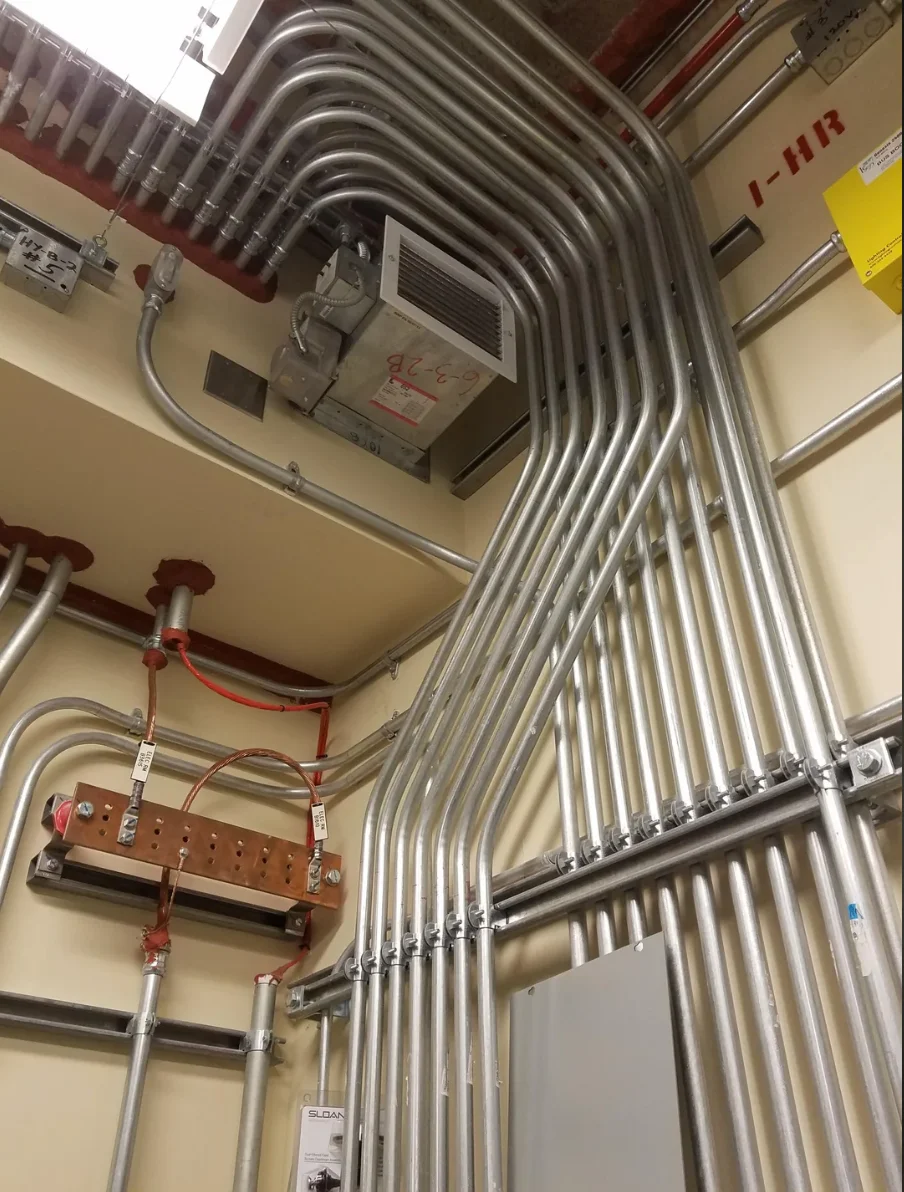
 
If you're working on parallel EMT offsets, it's a great idea to use pre-marked benders or a simple jig. Trust me, this can save you so much time and really boost your accuracy. Sure, you can try eyeballing it, but be prepared for some extra adjustments along the way
 
I think I understand that you want multiple pipes with offsets or saddles that match exactly.

If you want rows of parallel conduits with offsets- After the first pipe, advance or retard each subsequent bend by the tangent of half of the first bend angle times the spacing between bends. <. tan (a/2) x s. .>.

Maybe you know of these helpful booklets already, but just in case you don't, they have good information:
Electrician's Guide To Conduit Bending (Coxco.net). I think it has parallel offsets mentioned.
Ugly Book (Ugly.net)

And, Benfield Bending Guide is always handy.

Me?
I layout the first pipe and mark the pipe with a dry erase marker. Before bending, I write exact measurements of where the lines are. Then, the next, matching pipe, can be precisely laid out. You can end up with dozens of matching pipes.
This method is an absolute must for me with rigid. (Most of what I work with) The only change its that rigid is threaded before bending.

Paul
 
Last edited:
Most pros waste way too much time obsessing over perfect parallel bends...reality is, slight mismatches don't affect safety or function. If you're bending longer than 10 minutes, you're overengineering a simple job
 
Most pros waste way too much time obsessing over perfect parallel bends...reality is, slight mismatches don't affect safety or function. If you're bending longer than 10 minutes, you're overengineering a simple job
If one bends frequently, it becomes second nature (and fast) to lay out the first and then "lather-rinse-repeat". Perfect installations are a source of pride.

Many companies have dedicated "pipers" who fly through this stuff. (And they have dedicated pullers, tub fitters, termination people...) We look at the prints and give ourselves an "allowance" of time to complete the piping. It's a game. And- No Couplings Allowed!
Paul
 

Attachments

  • Eighty Minute Allowance.webp
    Eighty Minute Allowance.webp
    124.9 KB
Back
Top